
COVID-19 has forced companies over the world to enact, or create, remote working protocols. The likes of Box, Amazon, Airbnb, Facebook, Google and Microsoft have all told their employees some variation of “work from home”.
But then there are the more traditional organizations across fields such as real estate, accounting and local government.
Zoom team-selfies taken by giddy corporate executives who have been long-time remote working laggards, are polluting Twitter and LinkedIn feeds. But like most things worth doing, there are different levels of proficiency and sophistication to scale.
Many newly-remote workers seem to conflate simply downloading Zoom, Slack, and having access to email with having this remote working thing sorted out. But having a ball and a ring does not make an NBA star.
Working from home is, for the moment, a privilege and not a right for many, so let’s be more intentional about how we work, show that we can be more productive away from the office, and earn the right to work from wherever we please more often.
Below is an offer that we are offering for a limited time during this crisis. Cybersecurity is crucial working from home amidst COVID-19 scams posing a major threat to the security of your business. Get Your FREE Cybersecurity Training Course below and we will also perform a Free Dark Web Scan on your domain to make sure that your business was not compromised.
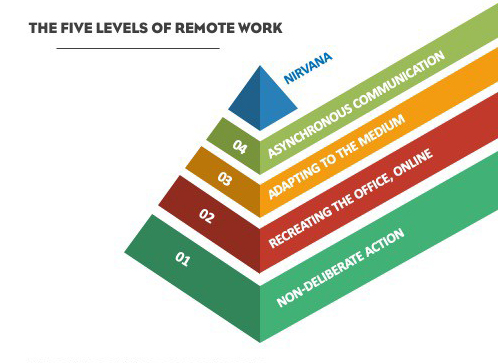
The Five Levels of Distributed Teams
Level 1: Non-Deliberate Action
Nothing deliberate has been done by the company to support remote work, but employees can still keep the ball rolling somewhat if they’re at home for a day. They have access to their smartphone, and email. Perhaps they dial in to a few meetings.
But they’ll put off most things until they’re back in the office, and will be a shadow of their office-bound selves.
Level 1 is where the overwhelming majority of organizations were prior to the COVID19 outbreak.
Level 2: Recreating the Office Online
This is where most organizations now reside — especially traditional ones.
It’s where your employees have access to videoconferencing software (eg. Zoom), instant messaging software (eg. Slack) and email, but instead of redesigning work to take advantage of the new medium, teams ultimately end up recreating online, how they work in the office.
This extends to many of the bad habits that permeate the modern office and suppress the ability of knowledge workers to actually think — here’s looking at you 10-person video-calls when two people would suffice, 60+ interruptions a day — now via Slack and phone calls, the sporadic checking of and responding to email more than 70 times a day throughout the day, or the hyper-responsiveness that is expected of all employees, leaving them wired to desktop dings like Pavlov’s dog.
Mullenweg equates lack of redesigning work around the medium with the radio drama of the 1930s, which was essentially the acting out of plays over the airwaves. Adapting the content to the radio medium was not fully considered or appreciated at the time.
It’s a little like many multi-million dollar digital transformation projects, whereby broken and redundant processes created in the 1980s are effectively digitised — but wait — they’re still broken, and they’re still redundant.
At Level 2, people are still expected to be online from 9 to 5, and in some cases to be subject to what essentially amounts to spyware, with employers installing screen-logging software on their employee machines so that they can play the role of Big Brother (see the Dictator’s Guide below for more like this).
If you’re at Level 2, you still have a long way to go.
Level 3: Adapting to the medium
At level 3, organizations start to adapt to and take advantage of the medium. Mullenweg points to shared documents (such as a Google Doc), that is visible to all and updated in real-time during a discussion, so that there is a shared understanding of what is discussed and decided, eliminating the risk of lost in translation errors and time wasted thereafter.
It’s at this stage that companies start to invest in better equipment for their employees as well, such as lighting for video-calls and background noise-canceling microphones.
Effective written communication becomes critical the more companies embrace remote work. With an aversion to ‘jumping on calls’ at a whim, and a preference for asynchronous communication (more on that later), most of Automattic’s communications is text-based, and so articulate and timely articulation becomes key.
In fact, Mullenweg says that most of the company’s hiring is performed via text as opposed to candidate phone or vide calls.
When it comes to meetings:
- Only hold a meeting if it is absolutely necessary and the same outcomes can’t be reached via a quick ad-hoc conversation, phone call, email, text or instant message.
- Set the meeting to 15 minutes by default, and only make it longer if absolutely necessary (the shorter the meeting, the more succinct you will have to be, and the less time there will be for pointless small talk and rambling).
- Set a specific agenda and desired outcome going into the meeting.
- Invite only ‘must have’ people (unless this is a big Type-1 decision, two people should usually do it with three on the rare occasion).
- Agree on next steps, allocate responsible person(s) and set due dates (this is especially important to avoid boomerang meetings).
- Never, ever, use a meeting simply to communicate information — that’s what email or IM is for. Many are indeed learning that all those meetings could have in fact been emails.
Level 4: Asynchronous Communication
‘I’ll get to it when it suits me.’ This is the nature of asynchronous communication.
The reality is that most things don’t require an immediate response. For most things, a one-way email or instant message should do the job, with the recipient responding when it suits them.
If something really is urgent, then the mode of communication should reflect that. Pick up the phone, or tap that person on the shoulder, but only if it is truly urgent.
Aside from the obvious and massive benefit of giving knowledge workers time to think, create and get into the flow state (a psychological state whereby we are up to five times more productive according to McKinsey), but asynchronous communication predisposes people to making better decisions.
As Robert Greene says, if you want to cut emotion out of the equation, increase your response time. Giving people time to think between question and response, rather than fall victim to blurting out the first thing that comes to mind in a meeting or when tapped on the shoulders, delivers a compound benefit to the organization over time.
In order to avoid tennis games and duplication of effort, ensure that asynchronous messages:
- provide sufficient background detail, where necessary provide clear action item(s) and outcome(s) required.
- provide a due date
- provide a path of recourse if the recipient is unable to meet your requirements.
For example:
Hey Shay
Attached is the incorporation document for our new spin-off company.
Please sign the document where requested and send it back to me by 4 pm this Friday.
If you have any concerns, give me a call on 555 1983.
Companies that truly practice asynchronous communication have stepped out of the industrial revolution, and no longer conflate presence with productivity, or hours with output, as one might on the factory floor.
Mullenweg points out that globally distributed teams, who work asynchronously, and master ‘passing the baton’, can get three times more done than a local team relying on everybody to be in an office between 9am and 5pm.
I’d argue that they could get an order of magnitude more done than a centralised company characterised by real-time and over-communication, as well as consensus-seeking meetings with everybody but the office dog present.
Awaken the Night Owls
A factor that went undiscussed in the conversation was that of chronotypes.
Science suggests that our preferred sleeping patterns — our chronotypes — are programmed at birth. People are either night owls or early birds.
Astrophysicist Sabrina Stierwalt wrote for Scientific American that:
our preferences for one or the other are encoded in genes called ‘clock’ or ‘period’ genes that regulate our circadian rhythms, and are linked to our blood pressure, metabolism, body temperature and hormone levels.
Several studies have found that about 30 to 40 per cent of the population are night owls, which means that the modern 9-to-5 workday is sabotaging the creative and intellectual efforts of almost half the workforce.
Stierwalt said that work days usually start between 7 and 9 am. However, night owls can experience ‘social jetlag’ if they wake up this early — that is, they can feel like they would if they had jetlag after an overnight flight. Early risers are less likely to experience social jetlag, giving them an advantage over night owls.
Studies show that while early risers are more alert in the morning, night owls show stronger focus and longer attention spans 10 hours after waking than their early-bird compatriots.
Asynchronous companies give night owls more flexibility to start their day later, so long as there is a workable overlap between them and their colleague’s day.
Level 5: ‘Nirvana’
This is where your distributed team works better than any in-person team ever could. Mullenweg equates this level with having more emphasis on ‘environment design’, insofar as the organization’s culture, and the physical environment people work in is concerned.
Cons: Cybersecurity
Mullenweg points to endpoint security —computer networks that are remotely bridged to client devices — and used for BYOD such as laptops and smartphones.
The alternative — being inside the office wall, as Mullenweg says —essentially becomes a single point of failure, and compromises depth in defence.
What we should be doing instead is rather than over-emphasising just access control, we need to be protecting against malicious behaviours. With over 70% of IT hacks using social engineering to get inside, he has a point.
Source: Steve Glaveski - The Medium

